sat suite question viewer
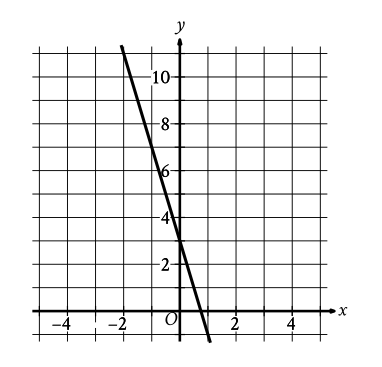
The graph of the linear function is shown. If and are positive constants, which equation could define ?
Explanation
Choice A is correct. It’s given that the graph of the linear function is shown. This means that the graph of can be translated down units to create the graph of and the y-coordinate of every point on the graph of can be decreased by to find the resulting point on the graph of . The y-intercept of the graph of is . Translating the graph of down units results in a y-intercept of the graph of at the point , or . The graph of slants down from left to right, so the slope of the graph is negative. The translation of a linear graph changes its position, but does not change its slope. It follows that the slope of the graph of is also negative. The equation of a linear function can be written in the form , where is the y-coordinate of the y-intercept and is the slope of the graph of . It's given that and are positive constants. Since the y-coordinate of the y-intercept and the slope of the graph of are both negative, it follows that could define .
Choice B is incorrect. This could define a linear function where its graph has a positive, not negative, y-intercept.
Choice C is incorrect. This could define a linear function where its graph has a positive, not negative, slope.
Choice D is incorrect. This could define a linear function where its graph has a positive, not negative, y-intercept and a positive, not negative, slope.